
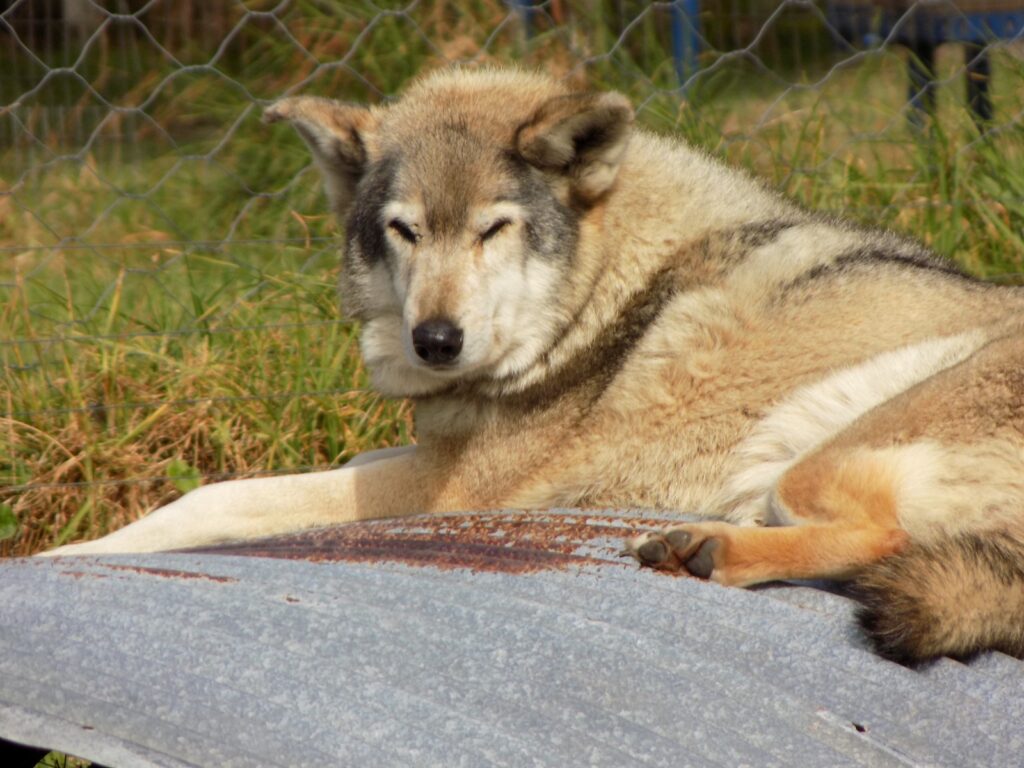
Grey wolves evolved for some of the coldest places on earth. Their natural range runs across the northern hemisphere, through forests and tundra where thick snow and hard winters are the norm. South Africa’s Eastern Cape is a long way from that, which makes summer the most demanding season of the year for the pack at the Tsitsikamma Wolf Sanctuary.
Built for the Cold
A wolf’s body is designed to hold heat in. They carry a dense double coat, a thick insulating undercoat beneath a layer of longer guard hairs, which is superb at trapping warmth through a freezing winter. The same coat that keeps a wild wolf alive in the snow becomes a burden in an African summer. Wolves cannot sweat through their skin the way people do; they rely mainly on panting to cool down, which is far less effective once the air itself is hot. On a cold night that coat is a lifesaver. On a hot Eastern Cape afternoon, it is the opposite of what the animal needs.
Watching for Heat Stress
Because wolves are so well insulated, the risk in summer is that they overheat, and a large animal in a heavy coat can move from comfortable to struggling faster than you might expect. Part of our job through the hot months is simply watching: heavy or constant panting, a wolf that seems listless or unwilling to move, or one that stays flat in the shade all day rather than showing its usual interest in what is going on around it. Catching those signs early and acting on them is far easier than dealing with a heat emergency later, so close daily observation becomes one of the most important things the team does.
Why Summer Is the Hardest Season
None of this is the wolves’ fault. They are here because wolves were brought to South Africa decades ago and their descendants cannot be released into a wild that was never theirs. That leaves us responsible for helping animals built for the cold stay comfortable in a climate they were never meant to face. Through the hottest months, that responsibility shapes the daily routine of the whole sanctuary.
How We Help the Pack Stay Cool
The enclosures are designed with heat in mind, with shade and cooler resting spots the wolves can retreat to through the worst of the day. Access to water is central, both to drink and to cool off in, and the wolves make good use of it when the temperature climbs. Daily care shifts with the season too, with the demanding work handled in the cooler parts of the morning and evening and the animals watched closely for any sign of heat stress. It is not glamorous work, but it is exactly the kind of constant, weather-driven care that keeps a cold-climate animal healthy in a warm country.
Small adjustments add up. Fresh water is checked and refilled more often as the temperature climbs, the heavier tasks are timed for the cooler ends of the day, and the wolves are given the space and quiet to do what suits them best in summer, which is very little. A wolf lying flat in the shade through a hot afternoon is not being lazy. It is doing exactly the right thing, and part of good care is simply making sure it can, undisturbed, with everything it needs close at hand.
A Challenge We Did Not Create
Helping wolves through an Eastern Cape summer is a clear reminder of why the sanctuary exists. These animals are managing a climate their bodies were never designed for, entirely because of human choices made long before they were born. Keeping them cool, hydrated and comfortable is part of the lifelong care we committed to. If you would like to support that work, you can donate to the sanctuary, or see how the pack lives for yourself on a guided tour.