
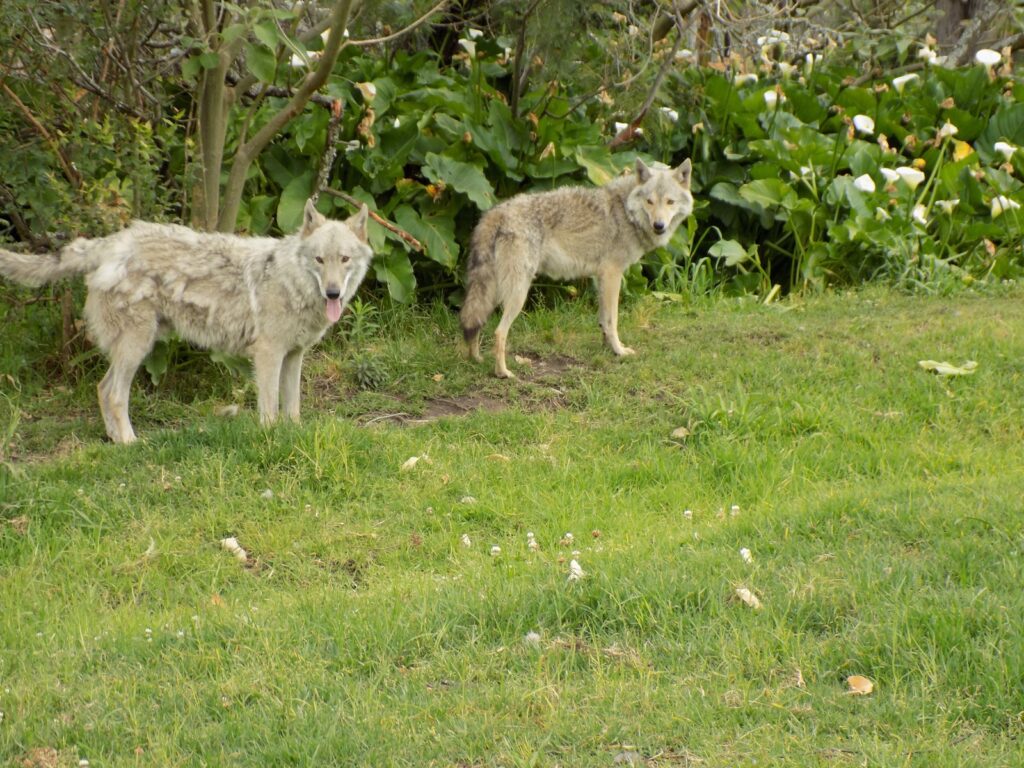
Spend enough time around wolves and you notice how much of what people assume about them does not hold up. Much of the popular image of the wolf, the lone hunter or the ruthless alpha, comes from old ideas that research has since revised. Here is some of what our own pack at the Tsitsikamma Wolf Sanctuary helps visitors understand about how wolves actually live together.
The Popular Alpha Wolf Story Is Misleading
Forget the familiar image of an alpha wolf constantly fighting to control the pack. In most wild wolf packs, the leading animals are the breeding pair, and the group is largely made up of their offspring. The alpha model became popular through observations of unrelated wolves living together in captivity, where social tension can look very different from the behaviour of a natural family group.
Females Lead Too
Leadership within a pack is not the role of one dominant male. The breeding female plays an equally important part in movement, decision-making, pup rearing and maintaining the group’s social structure.
A Howl Is Not a Cry of Loneliness
A howl is often read as something mournful, the sound of an animal alone in the dark. It is usually the opposite. A howl is a signal of belonging. Wolves use it to locate one another across distance, to mark and defend their territory, and to reinforce the bonds that hold the group together. When our wolves howl, they are not crying out in isolation. They are communicating with their pack.
Play Is Communication, Not Chaos
Wolves playing, running and mock-sparring can look like chaos to an untrained eye. It is anything but. What looks like rough and tumble is a constant conversation. Wolves communicate, set boundaries and express their place in the group through body language and play, usually without any real conflict at all.
Growing Up and Moving On
A wild pack does not stay the same size forever. As young wolves reach two or three years of age, they typically leave the pack they were born into to find a mate and territory of their own, and the cycle begins again. There is no violent overthrow and no battle for control. Understanding this makes the behaviour of a settled group far easier to read.
Quiet Bonds and Restraint
For all their reputation as fierce predators, some of the most striking moments at the sanctuary are the quiet ones. Wolves that share an enclosure often form close bonds, and much of pack life is spent resting, grooming and simply being near one another. There is real strength in a wolf’s restraint, in the way a powerful animal so often chooses calm over conflict. It is one of the things that most surprises visitors, and one of the things that makes watching a settled group so absorbing.
See It for Yourself
Reading about pack behaviour is one thing. Watching it unfold a few metres away is another, and it is exactly why every visit to the sanctuary is guided. Come and meet the pack on a guided tour of the sanctuary, or read more about how grey wolves came to live in South Africa.