
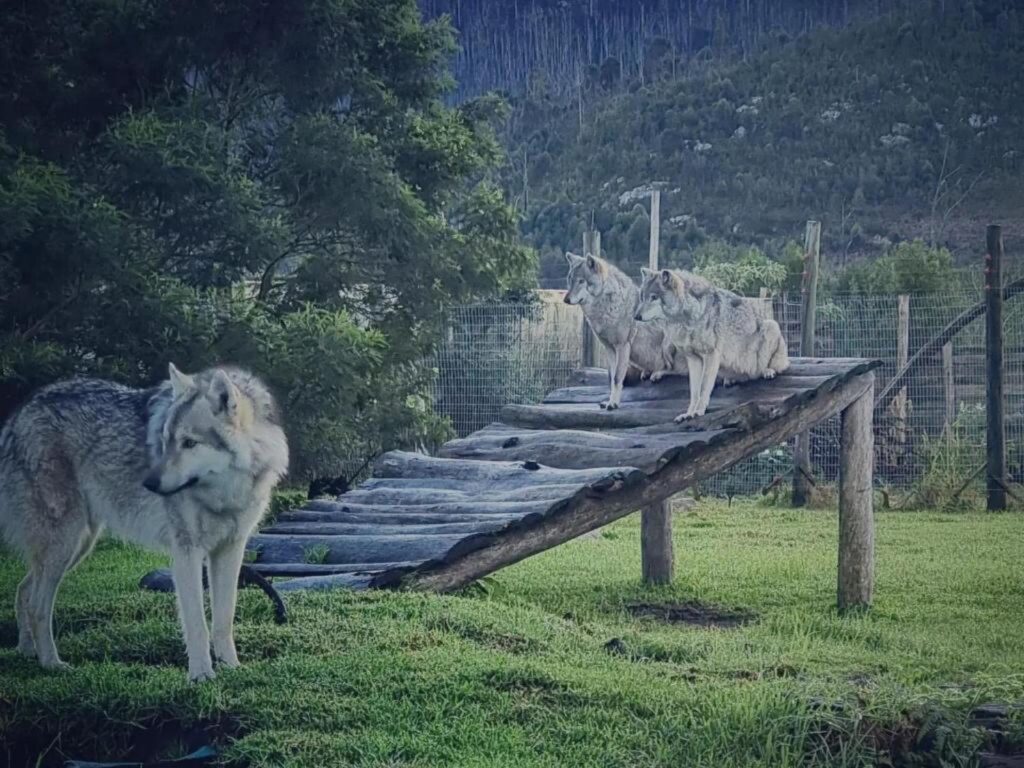
The wolves at the Tsitsikamma Wolf Sanctuary are fed and cared for, so they never need to hunt. Yet spend time watching them and you see the instincts of a hunter in everything they do: the awareness, the patience, the constant reading of their surroundings. To understand where that comes from, it helps to look at how wolves hunt in the wild.
Hunting Is a Team Effort
Wolves are best known as cooperative hunters. A wild pack works together to pursue prey far larger than any single wolf could tackle alone, animals like deer, elk or other large grazers. Success depends less on brute strength than on coordination: moving as a group, holding position, and responding to one another as a situation unfolds. A hunt is a shared effort, and the bonds that hold a pack together in daily life are the same ones that make it effective on the move.
A Family That Hunts Together
It helps to remember what a wild pack actually is. Rather than a gang of unrelated animals fighting for rank, a natural pack is usually a family: a breeding pair and their offspring from the last few years. The older, experienced animals lead, and the younger ones learn by doing, watching and gradually taking part. Hunting is not just instinct switched on at birth; it is a skill passed down, practised and refined within the family group. That shared learning is part of why wolves are so effective, and part of why a pack behaves so differently from a lone animal.
Strategy Over Strength
Wolves rarely rely on a simple chase. They test a herd first, watching for the animal that is older, weaker or slightly slower, and they will often travel long distances and expend real patience before committing. Most hunts end in failure, which is a crucial point that surprises many people. Far from the ruthless killing machines of legend, wolves succeed only a fraction of the time, and they survive by being selective, persistent and efficient rather than simply aggressive.
Reading the Environment
What makes wolves such effective hunters is their intelligence and their awareness of the world around them. They read terrain, weather, the movement of prey and the behaviour of their own pack, and they adjust constantly. Communication runs through all of it, in body language, positioning and sound, allowing a group to act almost as a single unit. This is the same sharp, strategic awareness you can see in a settled pack, in the way a wolf watches a visitor, notices a change in its enclosure, or tracks exactly where every other member of the group is.
It is worth pausing on how far this is from the wolf of fairy tales. The story we grow up with is of a mindless, bloodthirsty killer, forever huffing at doors and stalking the innocent. The real animal is cautious, intelligent and highly social, one that fails at most of its hunts, avoids unnecessary risk, and depends utterly on cooperation to survive. Understanding that gap between the myth and the animal is a large part of what the sanctuary is here to do, and it changes how people see every wolf they meet afterwards.
The Strategist in Every Wolf
Our wolves will never hunt, but the mind of a hunter is still very much present. Understanding that helps explain why wolves are so far from the simple predators of fairy tales, and why they are so absorbing to watch. If you would like to see that intelligence up close, come and meet the pack on a guided tour of the sanctuary, or read more about how grey wolves came to live in South Africa.